
When I saw the headlines screaming across my feed this week—"Earth Has a Second Moon!"—I’ll admit, my heart did a little zero-gravity flip. For a moment, I let myself imagine it: a new silver companion in the night sky, a fresh point of light for humanity to wish upon. As a scientist, I knew it was probably an oversimplification. But as a human, I was hooked.
The truth, of course, is a little more complex. The object, a tiny asteroid named 2025 PN7, isn’t a moon in the traditional sense. It’s not bound to us by the iron grip of gravity like our familiar Moon. But what it is might be even more profound. This little rock is what we call a "quasi-moon," and its story is a quiet, elegant lesson in cosmic timing and the subtle choreography of our solar system.
So, let's get the science out of the way. Headlines claiming NASA confirms Earth now has two moons until 2083 are wrong. We don't have two moons. What we have is a temporary dance partner. Imagine you're on a vast, circular running track. Now, imagine another runner on the same track, someone who has managed to match your pace so perfectly that for lap after lap, they're always just a few steps ahead or behind you. You aren't tied together, but you're in sync, sharing the same journey. That's 2025 PN7. It’s not orbiting Earth; it’s orbiting the Sun on a path so uncannily similar to ours that it’s become our cosmic shadow.
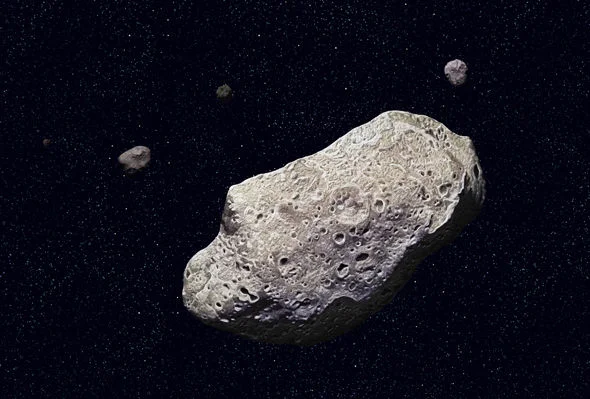
And when I say this thing is small, I mean it. At about 60 to 120 feet across, it’s small enough to fit inside a basketball arena. This isn't some world-shattering behemoth. It's a faint, humble traveler that has likely been keeping pace with us for 60 years, completely unnoticed until the sharp-eyed astronomers at Hawaii's Pan-STARRS observatory finally caught a glimpse of its ghostly movement. When I first read the confirmation from NASA, I honestly just sat back in my chair and smiled. This is the kind of discovery that reminds me why I got into this field in the first place—the universe is always, always more clever and more interesting than we give it credit for.
What truly elevates this story from a piece of cosmic trivia to something genuinely moving is the timeline. According to NASA's models, 2025 PN7 will continue this delicate dance with us until 2083. Then, its orbit will finally diverge, and it will drift away, pulled by the Sun into a new, lonely path through the void.
Think about that. This isn't a permanent feature. It’s a limited-time celestial event. We have been given a cosmic appointment.
This is our Halley’s Comet. For centuries, humanity has used that famous comet as a celestial clock, a reliable visitor connecting generations. But Halley’s is an old story, passed down through history. 2025 PN7 is our story. We are the first generation of humans to know it exists, to chart its course, and to know, with breathtaking precision, when it will say goodbye. The fact that we can model the gravitational tugs of planets with enough accuracy to forecast this little rock's departure six decades from now is just staggering—it means the gap between cosmic mystery and human understanding is closing faster than we can even comprehend, and it’s turning the solar system from a map of static objects into a living, breathing, predictable ecosystem.
This changes everything. A "quasi-moon" isn’t just a curiosity; it’s a potential stepping stone. These objects are gravitationally-speaking just a short hop away, making them incredible targets for future missions. They are nature’s own pre-positioned space stations. We could send probes, practice asteroid landings, or even test mining technologies without the immense energy and time costs of a deep-space mission. It's not held in our gravitational well—in simpler terms, it means we don't have to fight Earth's gravity to get there, making it an unusually accessible piece of extraterrestrial real estate.
But with this knowledge comes a new kind of responsibility, doesn’t it? Knowing we have these companions, even temporary ones, forces us to think more carefully about our own neighborhood. How do we approach these objects? As resources to be exploited, or as natural laboratories to be studied and preserved? The questions we ask about a tiny, harmless rock like 2025 PN7 will set the precedent for how we treat the rest of the solar system.
So, is this little asteroid dangerous? Absolutely not. At its closest, it's still ten times farther away than the Moon. You won't see it with the naked eye. It won't cause tides or inspire poetry. But its value isn't in its visibility; it's in its existence. It’s a silent testament to the fact that there are still profound secrets hiding in plain sight, waiting for a curious eye and the right set of equations to bring them into the light. What other dance partners have we missed? What other celestial appointments are waiting to be discovered in the data?
In the end, the fact that 2025 PN7 is leaving is precisely what makes it so beautiful. It’s not a monument. It’s a moment. For the next six decades, we share our journey around the Sun with this tiny, silent companion. It’s a cosmic memento mori, a reminder that the universe is not a static museum of objects but a dynamic, flowing, and ever-changing river of orbits and gravity. Its presence is a gift, a fleeting alignment in a 4.5-billion-year-old story, and we just happen to be the ones lucky enough to be alive to see it. So, no, we don't have a second moon. We have something better: a reason to look up and appreciate the profound, temporary beauty of right now.